Save 1/100th of a tree
 Buy the eBook
Also available at
Chapters Indigo,
Amazon,
iUniverse and more
![[Image: Econogics logo]](../econlogo.gif)
Insulated Window Coverings
Last updated 2023.10.22
After a decade away from this activity, Econogics is now considering re-entering the business of custom-made insulated household window coverings, as the desire for reducing energy use and our personal contributions to climate change is growing. If you are interested, please contact us for details and an estimate on pricing. Each covering is made to your specification, including the pattern or image on the inward facing side of the piece.
What are insulating window coverings?
In simple terms, it's a blanket (quilt) to reduce heat transfer through your windows. In cold weather, windows are usually the single largest source of heat loss from our homes. While walls vary in their insulating capacity from R12 (common building code value in cold climates) to R40 (typically considered super-insulated), windows may be as poor as R2. Low-Energy, argon-filled, double pane, vinyl-cased windows are typically R3 to R4. Very high quality, high efficiency windows may achieve R6 or R7. Check out the product line from [dead site: http://www.1st-replacement-windows.com/] 1st replacement windows.
I don't have any scientific data, but I'm guessing the quilt we use on our window (as illustrated here) has an effective R-value of about 4 to 5. That's about the same as an inch of styrofoam board. It certainly made a huge difference in the perceived warmth in the room.
How Windows Lose Heat
There are 3 ways windows lose heat from your house: conduction, convection and radiance. Conduction is the simple transfer of heat energy by contact from the warm air in the room, to the glass, to the cold air outside. (In the case of double glazed and triple glazed units, conduction losses are slowed by creating more layers to be crossed, including insulating layers of air or inert gas.) Convection is the loss caused by moving air. Radiance is the loss of infrared energy simply transiting the window barrier as light energy, to which the windows are fairly transparent. The quilt covering our window addresses all three heat-loss modes. It creates an additional boundary layer between the warm air in the room and the cold air outside – in fact, 4 layers of boundary, to reduce conduction loss. By hanging against the window frame, it prevents air from flowing from the room to the window surface, reducing convection loss. Finally, by including a radiant barrier within the quilt, it reduces radiant heat loss.
Traditional window coverings tend to be a single layer or two of fabric, which are hung a distance away from the window (5 to 10 cm, or 2 to 4 inches). The fabric presents a minimal barrier to heat loss. Because of the air space between the window and the curtain, warm air from your room is free to move to the window glass, and give off heat via conduction. Worse, there will likely be convection effects. As the air cooled by the window becomes denser, it falls to the floor. Warmer air from the sides of the curtains fill in behind, cooling and falling to the floor, creating circular loops that continue conveying warm air to the window to cool. During the heating season, that is literally your money (energy bill) going out the (closed) window.
You wouldn't go to bed on a cold winter night with just a bedsheet, and you certainly wouldn't suspend it 4 inches above you, with the sides open. Same deal for the heat in your room escaping via your windows.
The Quilt on Our Window
By hanging the quilt on our window when the sun goes down each day, we reduce the heat loss from our windows when we want to keep the heat in. By taking it down when the sun is shining, we get the maximum benefit from passive solar heat gain from our sun-facing windows when we want it. The insulated window covering (and a bit of discipline) let's us have the best of both worlds from our windows. Further, many window installations are the source of drafts, allowing cold air in and warm air out. Putting a quilt over the window, and having it hang around the outside of the frame can help block or at least slow the cold air infiltration. Still, it is no substitute for proper weather sealing.
Quilt from inside, with vertical blinds
open (248 KB - wall is dark blue-grey, window frame is white,
blinds are grey, fabric strips in quilt are various blues and
complementary colours)
Quilt from
inside, with vertical blinds closed (111 KB - not
visible)
Quilt from outside (183 KB
- unobtrusive to neighbours, especially at night – item at
bottom is our solar water pre-heater – the rings at the
corners of the window glass are for attaching shade cloths)


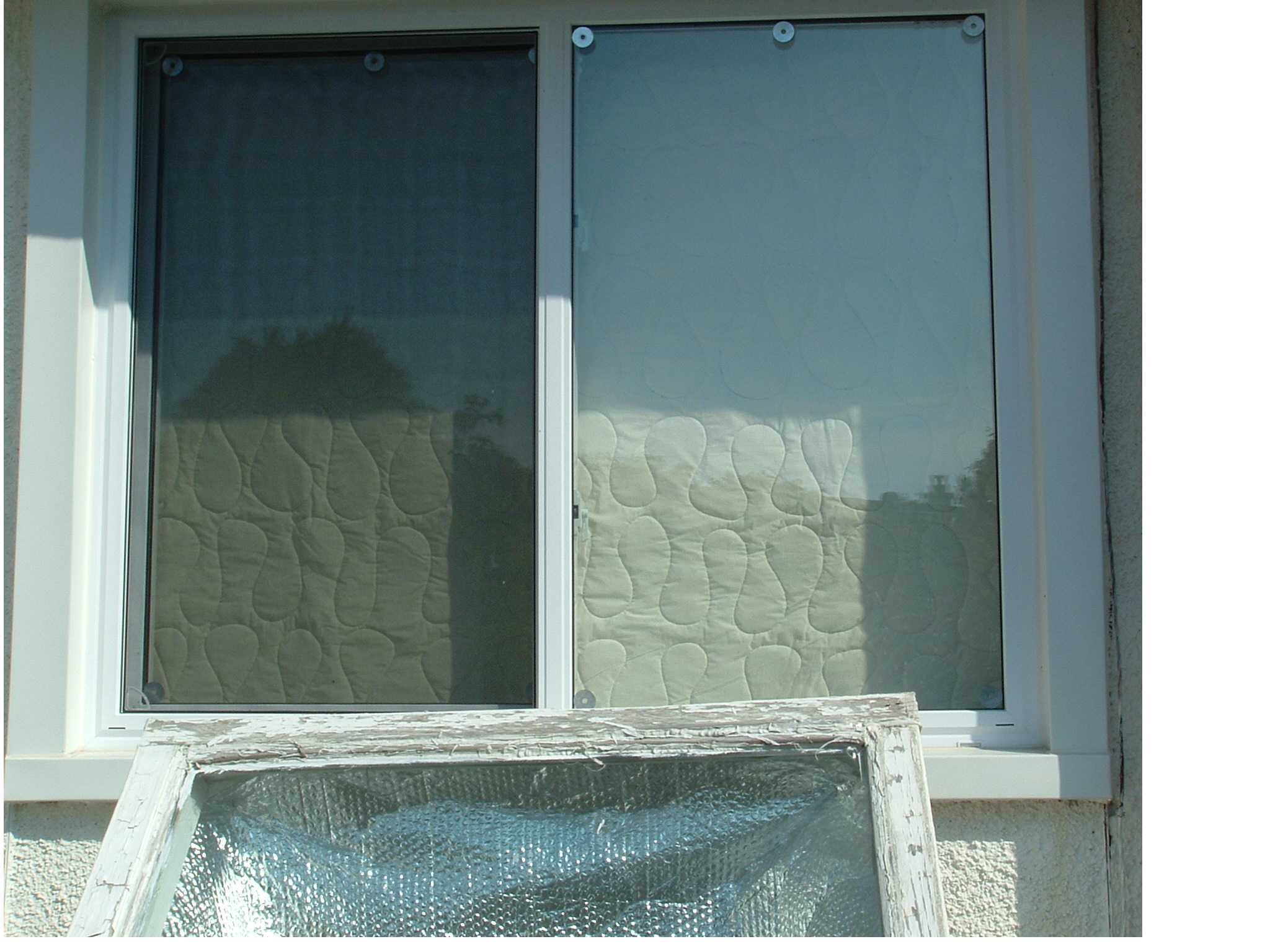
Our window covering is based on conventional quilting techniques. It uses the warmest batting (highest insulating value) we could find available commercially, and a layer of aluminized mylar as a radiant barrier. Cotton fabric is used on both sides for strength and aesthetics.
By using a light coloured fabric on the reverse side, there is also some reflective benefit against solar gain in the summer, helping keep the house cooler. Not as effective as the shade cloth, but the two can be used together.
That should provide enough information for you to make your own. We recommend machine washing on a gentle cycle, and hang to dry. The mylar sheet does not respond well to clothes dryer temperatures.
Other Ways of Insulating Windows
Insulating Polystyrene Panels (Foam Board)
Another option for many windows is to buy polystyrene insulating board (either the extruded board which is typically pink or blue, or the pebble board which is usually white; we prefer the extruded board) and cut it to fit the opening, just snug enough to stay in place. Insert in the evening and remove again in the morning. You can glue fabric to the inward side of the panels for aesthetics, and aluminized mylar to the window facing side to improve reflectivity against summer solar gain.
Insulated Window Blinds
Another commercially-available option is the insulated window blind. These have a compressible insulation built in, and the blind can be raised to let sun in, and lowered to keep heat in.
Plastic Wrap
We still prefer the quilt combined with clear plastic in the winter to reduce drafts and improve the insulation, but it's likely a matter of taste as to which you will prefer.
If you are prepared to take on the daily task of installing / removing or raising / lowering insulated window coverings, they will provide you with a better investment than upgraded windows. Lower initial cost and better insulation capability mean a better return (savings) on your energy efficiency investment, and that means less energy used and a healthier planet.
Water Savers | Econogics Blog | Products and Services | Electric Vehicles | Reducing Your Expenses | Personal Energy Plan | The Emperor's New Hydrogen Economy
This website is powered by renewable
energy.
Return to Econogics Home Page
All material on this Web site is copyrighted by Econogics, Inc. (unless otherwise noted).
This Web site created, maintained and sponsored by Econogics, Inc.
Comments to: Webmaster are welcomed.